Overview

Primus FHE
What is FHE?
Fully Homomorphic Encryption (FHE) is a form of encryption that allows arbitrary computations to be performed directly on encrypted data, without ever decrypting it. The result of the computation remains encrypted and, when decrypted by the data owner, matches exactly what would have been obtained had the same operations been performed on the plaintext. This property removes the traditional trade-off between using data and protecting it: a party can outsource computation to an untrusted server, cloud, or network, and that party never needs to see the underlying data to process it correctly.
The concept dates back to the late 1970s, but it remained a theoretical curiosity until Craig Gentry's 2009 breakthrough, which introduced the first construction supporting unlimited computation on ciphertexts. Since then, FHE schemes (such as BGV, BFV, CKKS, and TFHE) have matured significantly, with steady improvements in efficiency through techniques like bootstrapping, packing, and hardware acceleration. While FHE is still computationally heavier than working on plaintext, it has moved from a purely academic construct to a practical tool used in privacy-preserving machine learning, secure multi-party computation, and confidential data processing.
In crypto, FHE lets smart contracts and off-chain compute networks operate directly on encrypted state, enabling use cases like confidential transactions, private DeFi logic, encrypted on-chain voting, and secure computation on sensitive financial or identity data. Because inputs, intermediate state, and outputs never need to be decrypted during processing, privacy is enforced by the cryptography itself rather than by trusting an operator or validator to behave honestly.
Primus FHE Techniques and Solutions
Primus FHE techniques focus on solving industrial problems and practical applications. In particular, Primus brings FHE to blockchains and smart contracts, enabling secure and private computation on sensitive data and providing privacy infrastructure for existing blockchains and institutional-grade finance on-chain. The Primus team has dedicated itself to FHE research and development since 2023, working toward industrial-grade solutions that close the persistent gap between cryptographic theory and practical industry problems.
FHETransform: Primus FHE Computation Framework
The core technical product is FHETransform, a framework that powers privacy-preserving computation on EVM-compatible blockchains. It lets developers build confidential smart contracts, whose inputs, state, and outputs stay encrypted end to end, while keeping the decentralization, composability, and security guarantees of the underlying chain.
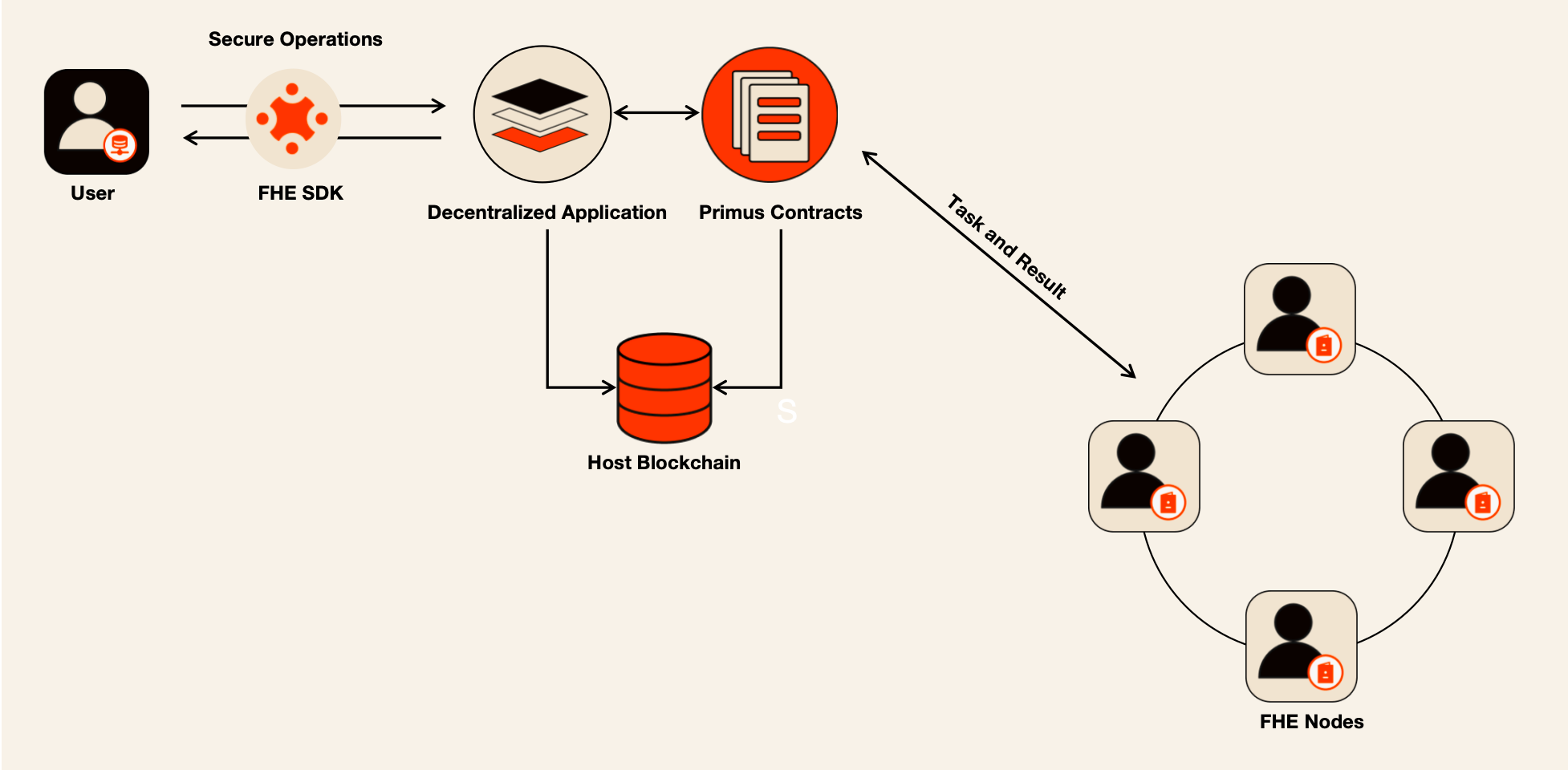
Conceptually, the architecture of privacy-preserving applications on FHETransform consists of three main components:
- Privacy decentralized applications (dApps): Developers write standard smart contracts and use the Primus FHE toolchain to automatically transform them into confidential contracts with FHE support.
- On-chain coordination layer: This layer consists of smart contracts deployed on the host blockchain. It performs symbolic execution by manipulating compact ciphertext handles, enforcing access control, coordinating decryption requests, and settling payments. It does not execute any computationally intensive cryptographic operations.
- Off-chain execution layer: This layer consists of FHE nodes and the key management service (KMS). It performs the actual cryptographic computation, including encrypting user inputs, executing homomorphic operations over encrypted data, and decrypting results when authorized. The FHE keys are currently managed by the Key Management Service (KMS), including key generation and rotation, with the secret key securely isolated inside a Trusted Execution Environment (TEE). In the long term, the KMS will evolve into a threshold Multi-Party Computation (MPC) network, reducing the trust assumption from relying on a single trusted enclave to requiring only an honest threshold of participating nodes.
For further details of FHETransform, readers can refer to the official documentation.
Primus FHE for On-Chain Finance
As stablecoins and tokenized assets become a core part of finance, more cash, credit, treasuries, and real world assets are moving on-chain. On-chain infrastructure is increasingly becoming a default financial rail for both institutions and individuals.
Yet privacy remains a fundamental gap. New chains such as Canton, Arc, and Temple embed privacy at the infrastructure level, but primarily serve liquidity willing to move to those ecosystems. Most activity still runs on established networks like Ethereum, where payment, payroll, treasury, and financial applications already operate.
Primus addresses this gap by bringing privacy to existing networks and financial rails, without requiring liquidity to migrate to a new chain. It's a pluggable privacy solution for stablecoins and other assets, extending their utility into confidential asset management and privacy-preserving finance, all on existing blockchain infrastructure. By leveraging controllable and programmable FHE computation, the solution ensures confidentiality without sacrificing compliance.
Find out more details here.
zkFHE: A Verifiable FHE Protocol
In parallel, Primus is also researching and developing zkFHE, often referred to as verifiable FHE (vFHE) that combines the privacy guarantees of FHE with cryptographic proofs of computation correctness. Note zkFHE is not a straightforward combination of zero-knowledge proofs and fully homomoprhic encryption schemes together, but a special type of FHE schemes that support the verification of homomorphic computations.
The motivation behind such a protocol is to ensure the correctness of outsourced computations over encrypted data. In practical settings, a computing node may behave maliciously by returning an incorrect computation result while still producing a ciphertext that can be successfully decrypted and treated as the computation result. Without additional verification mechanisms, the client has no reliable way to determine whether the computation was performed correctly or whether the result was arbitrarily fabricated. Traditional FHE schemes provide confidentiality but do not guarantee computational integrity. This lack of verifiability represents a significant limitation for many privacy-preserving applications, where both input data confidentiality and computation correctness are essential.
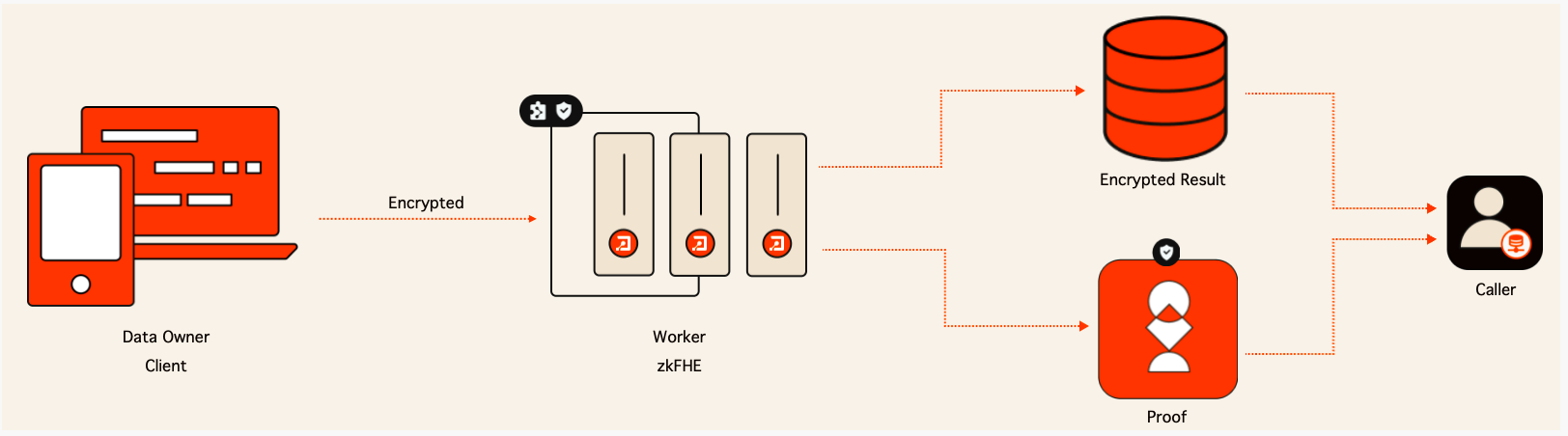
zkFHE provides an ideal solution to this challenge. During homomorphic computation, a cryptographic proof is generated alongside the computation result. The client can then verify the proof to ensure that the computation was executed correctly and that the service provider has not tampered with or falsified the result.
Primus team has designed a zkFHE protocol named "HasteBoots" in the paper of Usenix Security 2026. The HasteBoots paper lays the foundation for practical zkFHE, but substantial work remains to transform this research into a scalable and production-ready solution. Addressing challenges in performance, proof generation, and system engineering will require continued innovation and long-term investment. Primus is committed to advancing this vision through ongoing research and development.